
1960s
• Electronic musical instruments started to emerge, including synthesisers and sequencers
WEM Nightshade Synthesiser
There was a lack of standardised communication protocols between different electronic instruments
1970s
• Electronic instruments had become more advanced over the decades as well as more affordable to a wider demographic
• Instruments had ways of communicating before the advent of MIDI, most notably through the use of Control Voltage (CV) signals, however, these methods of communication still had their drawbacks:
- Instruments from different manufacturers were not always able to communicate with one another due to manufacturers using proprietary communication protocols
- When using polyphonic instruments, a separate CV signal was required for each voice

CV/Gate Ports on a synthesiser
1980s
• Dave Smith proposed a universal communication standard for electronic musical instruments and collaborated with other manufacturers to develop the MIDI (Musical Instrument Digital Interface) standard. which is introduced in 1983
• MIDI began to be adopted by many instrument manufacturers and became a standard feature in synthesisers, drum machines and sequencers
•MIDI Time Code (MTC) and MIDI Machine Control (MMC) protocols were also developed to allow MIDI to synchronise with recording equipment

DigiDesign Command 8 Control Surface
MIDI sequencing software and hardware became popular, revolutionising music production by enabling precise control over composition and arrangement
1990s
• Personal computers became more powerful and therefore able to handle MIDI sequencing and editing tasks
- DAWs with MIDI capabilities emerged, allowing musicians to compose, record and edit music all digitally
• MIDI technology became integral to the development of EDM genres such as techno, house and trance
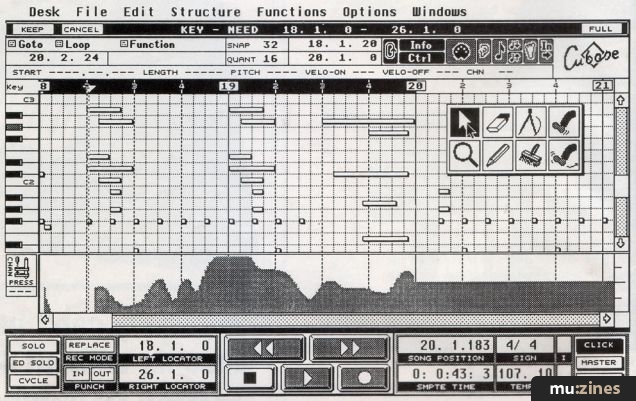
Cubase DAW
2000s
• More MIDI protocols are introduced to facilitate connectivity between MIDI devices and computers
- MIDI-over-USB
- MIDI-over-Ethernet
• Web-based MIDI technology emerges allowing browser-based music applications and interactive experiences

Soundtrap – Browser Based DAW
MIDI continues to evolve, with efforts to develop MIDI 2.0 to address the limitations of the original standard
2010s
• The development MIDI 2.0 was announced which aimed to enhance expressiveness, increase resolution and improve interoperability with modern music technology
MIDI remains a fundamental tool for musicians, producers and composers, continuing toi shape the landscape of music creation and performance
Wider Context Topic Timelines – MIDI
Why not check out one of these videos below to gain some wider knowledge:
 WLFS Music Technology